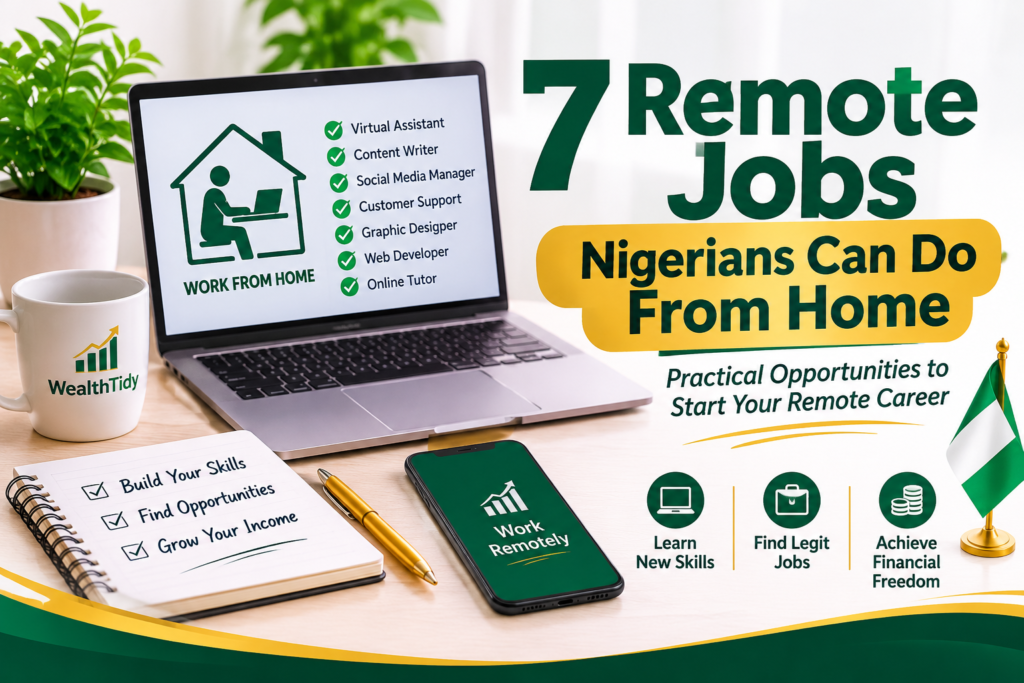
Finding a job that allows you to work from home is becoming an attractive option for many Nigerians. Whether you are a fresh graduate, a working professional looking for extra income, a student with useful skills, or someone who wants more flexibility, remote work can open doors to opportunities beyond your immediate location.
The good news is that you don’t need to be a software developer or have years of experience to start working remotely. Companies and business owners need people who can communicate with customers, manage social media accounts, write content, organise information, design graphics, and handle everyday business tasks.
However, getting a legitimate remote job takes more than owning a laptop and having internet access. You need a marketable skill, a professional application, and the ability to deliver quality work without someone constantly supervising you.
In this guide, we will explore 7 remote jobs Nigerians can do from home, the skills each one requires, and practical places to look for opportunities.
What Are Remote Jobs?
Remote jobs are employment opportunities that allow you to perform your duties outside a traditional office. Instead of travelling to an employer’s workplace every morning, you use digital tools such as email, video meetings, messaging applications, and project management platforms to complete your responsibilities.
Some remote positions are full-time jobs with regular salaries. Others are part-time, contract-based, or freelance opportunities where you are paid for specific tasks or projects.
It is also important to understand that remote does not always mean worldwide. Some employers only accept applicants who live in the United States, the United Kingdom, or another approved country. Before applying, check whether the employer accepts candidates based in Nigeria.
7 Remote Jobs Nigerians Can Do From Home
You do not have to pursue all seven opportunities. Choose one that matches your interests, existing abilities, and the amount of time you can commit to learning.
1. Virtual Assistant
A virtual assistant provides administrative and organisational support to business owners, entrepreneurs, and companies from a remote location.
Think of this role as being an office assistant, except you perform most of your duties online.
Your responsibilities may include:
- Managing emails and responding to routine enquiries.
- Scheduling appointments and organising calendars.
- Preparing documents and presentations.
- Conducting online research.
- Updating spreadsheets and databases.
- Organising meetings and following up on tasks.
- Providing basic customer support.
Skills you need
You should be organised, reliable, detail-oriented, and comfortable communicating professionally. Basic knowledge of Microsoft Office, Google Workspace, spreadsheets, and calendar management will also help.
Who can consider this job?
People with administrative, customer service, office support, or secretarial experience may find this role easier to transition into. Beginners can also learn the necessary tools and build sample projects.
Where to find opportunities
Explore Upwork, LinkedIn Jobs, and Jobberman.
2. Freelance Writing and Content Creation
If you enjoy writing and can explain ideas clearly, freelance writing may be worth exploring.
Businesses need written content to educate customers, attract website visitors, promote products, and build their online presence. This creates opportunities for writers who can produce useful and well-researched content.
As a freelance writer, you may work on:
- Blog posts and website articles.
- Product descriptions.
- Email newsletters.
- Website pages.
- Social media captions.
- Business reports and guides.
- Search-engine-optimised (SEO) articles.
Skills you need
You need good grammar, research skills, clear communication, and the ability to organise information. Learning SEO writing can also improve your opportunities because many businesses want content that is useful to readers and easy to discover through search engines.
You do not need to know everything before starting. Choose a subject you understand, practise writing, and create a few strong samples.
Where to find opportunities
Try Upwork, Fiverr, ProBlogger Jobs, and LinkedIn.
You can also contact businesses with websites or blogs and offer to help improve their content.
3. Social Media Manager
Many businesses understand that social media can help them reach customers, but they do not always have the time or knowledge to manage their accounts properly.
That is where a social media manager comes in.
Your job may involve planning content, writing captions, creating simple graphics, scheduling posts, responding to comments, and reviewing account performance.
Some businesses may also expect you to help develop campaigns and improve engagement.
Skills you need
You should understand how platforms such as Facebook, Instagram, TikTok, and LinkedIn work. Writing, creativity, communication, basic graphic design, and content planning are useful skills.
You should also learn how to use tools such as Canva and Meta Business Suite.
How to get started
Choose a business or personal brand and create a sample one-week content calendar. You can also practise designing social media posts and writing captions for imaginary business campaigns.
These samples can become part of your portfolio when approaching potential clients.
Where to find opportunities
Search on LinkedIn Jobs, Jobberman, and Upwork.
Small businesses, online stores, consultants, and content creators may also need help managing their social media accounts.
4. Customer Support Representative
Customer support is another remote career worth considering, especially if you enjoy communicating with people and solving problems.
Companies need customer support representatives to answer questions, handle complaints, explain products, and help customers resolve issues.
Depending on the employer, you may communicate through:
- Email.
- Live website chat.
- Telephone calls.
- Social media messages.
- Customer support ticketing systems.
Skills you need
Good written and spoken communication is essential. You should be patient, professional, attentive, and capable of handling difficult conversations.
Some employers provide training on their products and customer service systems. Others prefer applicants with previous customer service experience.
You may also need a quiet working environment, a reliable internet connection, and a suitable computer. For telephone support, a good headset is often necessary.
Where to find opportunities
Check Jobberman, LinkedIn Jobs, and We Work Remotely.
Before applying, confirm that the company accepts applicants from Nigeria and check its working-hour requirements. Some international customer support positions require employees to work according to another country’s time zone.
5. Graphic Designer
If you enjoy creating visual content, graphic design can become a valuable remote-work skill.
Businesses use graphics to advertise products, communicate ideas, build brand identities, and attract customers. They regularly need designers to create professional visual materials.
Common graphic design projects include:
- Social media graphics.
- Business logos and brand materials.
- Flyers and promotional banners.
- YouTube thumbnails.
- Presentation designs.
- Digital product covers.
- Marketing materials.
Skills you need
You need an understanding of layout, colour combinations, typography, spacing, and visual communication.
You can start learning with beginner-friendly tools such as Canva. As your skills improve, you may explore professional software such as Adobe Photoshop and Illustrator.
How to get started
Do not wait until someone gives you a paid project before practising. Create sample designs for different businesses, such as a restaurant, clothing brand, finance company, or beauty business.
Put your best work into an online portfolio so potential clients can see what you can do.
Where to find opportunities
Explore Fiverr, Upwork, and LinkedIn Jobs.
6. Web Developer or WordPress Website Designer
Every business needs an online presence, and websites remain an important part of how companies attract customers and provide information.
Web developers build and maintain websites, while WordPress designers often use WordPress themes, plugins, and page builders to create websites without writing every part of the code from scratch.
Depending on your skills, you may work on:
- Business websites.
- Personal blogs.
- Online stores.
- Landing pages.
- Website redesigns.
- Website maintenance and updates.
- Fixing basic website problems.
Skills you need
If you want to become a web developer, learning HTML, CSS, JavaScript, and other programming languages can help you build a strong foundation.
If you prefer website design, you can begin with WordPress, website layouts, themes, plugins, and page builders.
You should also understand basic website security, mobile responsiveness, and user experience.
How to get started
Build two or three sample websites to demonstrate your ability. For example, you could create a website for a small business, a personal portfolio, and an online store.
You do not need to wait for a client before building your portfolio.
Where to find opportunities
Look at LinkedIn Jobs, Upwork, Fiverr, and We Work Remotely.
You can also approach small businesses that need new websites or improvements to their existing ones.
7. Online Tutor
If you are knowledgeable in a particular subject and enjoy teaching, online tutoring may be another option.
Students and learners use the internet to find tutors who can help them understand difficult subjects, prepare for examinations, or develop new skills.
You could teach:
- Mathematics.
- English language.
- Science subjects.
- Computer skills.
- Programming.
- Business-related subjects.
- Languages you can confidently teach.
Skills you need
You should understand the subject you want to teach and be able to explain concepts in a simple, patient manner.
You will also need a reliable internet connection, a computer or suitable device, and a quiet place to conduct lessons.
Some tutoring platforms require qualifications, teaching experience, or assessments before accepting tutors. Always check their requirements.
Where to find opportunities
Explore Preply, TeacherOn, and LinkedIn Jobs.
You can also advertise your tutoring services independently and conduct lessons through online meeting platforms.
Where Can Nigerians Find Legitimate Remote Jobs?
Knowing which job you want is only the first step. You also need to know where to search.
Here are some platforms worth exploring:
1. LinkedIn: Useful for professional opportunities across different industries. Search for your preferred job title, select the remote option where available, and check the location requirements.
2. Jobberman: A Nigerian job platform where you can explore work-from-home vacancies and other local employment opportunities. Start with its remote jobs section.
3. Upwork: A freelance marketplace where businesses hire independent professionals for writing, design, virtual assistance, development, and other services.
4. Fiverr: Allows freelancers to offer specific services to clients. You can create service listings around skills such as graphic design, writing, video editing, and website development.
5. We Work Remotely: A remote-work job board featuring opportunities across areas such as programming, marketing, design, and customer support. Check each listing to confirm whether applicants from Nigeria are eligible.
6. WorkAfro: An Africa-focused remote job platform. Its country filters can help you explore opportunities advertised for people living in Nigeria and other African countries. Visit WorkAfro.
Remember that these platforms are places to discover opportunities, not guarantees that every vacancy is genuine or available to Nigerians. Whenever possible, verify the opening on the employer’s official careers page.
How to Prepare Yourself for a Remote Job
You may find an opportunity that looks perfect, but applying without preparation can reduce your chances of getting hired.
Before sending out applications, work on these areas.
1. Choose One Skill to Develop
Avoid trying to learn everything at once. Pick a role that matches your interests and strengths.
For example, if you enjoy organising tasks, virtual assistance may be a good starting point. If you enjoy writing, focus on content creation. If you are interested in technology, explore web development.
Concentrating on one skill makes it easier to practise and demonstrate improvement.
2. Build a Portfolio
A portfolio is evidence of what you can do.
You do not necessarily need previous employment experience to create one. You can develop sample projects that demonstrate your ability.
A beginner writer can publish sample articles. A graphic designer can create promotional designs. A virtual assistant can prepare a sample calendar and spreadsheet.
The goal is to show employers that you understand the work and can produce useful results.
3. Prepare a Professional CV
Your CV should clearly explain your skills, experience, education, and relevant achievements.
Avoid filling it with unnecessary information. Instead, focus on what makes you suitable for the particular position.
If you are applying for a customer support role, highlight communication and problem-solving experience. If you want a social media position, include content planning, design, and account management skills.
4. Improve Your LinkedIn Profile
Your LinkedIn profile can help recruiters understand your professional background.
Use a clear photograph, write a useful headline, include relevant skills, and describe your experience properly.
You can also indicate that you are interested in remote opportunities and set job alerts for relevant positions.
LinkedIn provides filters for narrowing job searches, including remote work and employment type. You can learn more through its official job-search guidance.
5. Prepare Your Work Equipment
Most remote jobs require a suitable device and dependable internet access.
Depending on the position, you may need:
- A laptop or desktop computer.
- Reliable internet access.
- A backup internet option where possible.
- A smartphone for communication and verification.
- A quiet and organised working space.
- A headset for calls and virtual meetings.
You do not need an expensive home office to begin, but you should be able to complete your responsibilities reliably.
How Much Can You Earn From Remote Jobs?
Remote income varies widely. Your earnings depend on the type of work, your experience, the employer, the country where the company operates, and whether you are hired as an employee or an independent contractor.
For example, an entry-level virtual assistant may earn less than an experienced software developer. A freelance writer with a strong portfolio may charge more than someone who is just starting.
Some companies pay in naira, while international employers may offer compensation in dollars, pounds, or other currencies.
Do not choose a remote job based on the advertised salary alone. Consider the workload, payment terms, working hours, platform fees, exchange costs, and whether the employer can legally hire someone living in Nigeria.
Most importantly, be cautious of online adverts promising thousands of dollars every month for simple tasks that require no experience. Real opportunities usually come with clear responsibilities and reasonable selection processes.
How to Avoid Fake Remote Job Offers
Unfortunately, the popularity of remote work has also created opportunities for scammers.
Some fraudulent adverts promise easy money, flexible working hours, and immediate employment. Their real intention may be to collect money or personal information from unsuspecting applicants.
Watch out for these warning signs:
1. Registration fees: A supposed employer asks you to pay before you can apply, attend an interview, or receive a job offer. Be suspicious of anyone charging you for the promise of employment.
2. Unrealistic salary promises: An advert promises unusually high earnings for very simple tasks without explaining the responsibilities or qualifications required.
3. No verifiable company information: You cannot find a credible company website, official contact details, or a genuine description of the business.
4. Pressure to act immediately: The recruiter insists that you must pay, submit sensitive information, or accept an offer immediately without allowing you time to verify the opportunity.
5. Requests for unusual payments: Someone sends you a cheque and asks you to return part of the money, purchase gift cards, or transfer funds elsewhere. Do not participate.
6. Suspicious communication: The recruiter refuses to use official company channels and insists on conducting the entire recruitment process through an unverified WhatsApp or Telegram account.
Before accepting an offer, visit the company’s official website and confirm that the vacancy exists. If you are unsure, contact the company through independently verified contact details.
The US Federal Trade Commission’s job scam guidance also explains common warning signs and ways to protect yourself.
A Simple 30-Day Plan to Start Your Remote Job Search
If you are serious about working remotely, you need a practical plan rather than endlessly browsing job adverts.
Here is a simple way to use your first 30 days.
During the First Week: Choose Your Direction
- Select one remote job that interests you.
- Research the responsibilities and required skills.
- Identify the tools commonly used in that profession.
- Write down the skills you need to improve.
In Week Two: Learn and Practise
- Follow relevant tutorials or structured lessons.
- Practise using the tools required for your chosen role.
- Complete small exercises or sample projects.
- Ask for feedback and improve your work.
By the Third Week: Build Your Professional Profile
- Prepare or update your CV.
- Create a portfolio with your best samples.
- Improve your LinkedIn profile.
- Write a short professional introduction.
Week 4: Start applying
- Search for relevant remote vacancies.
- Confirm that the employer accepts applicants from Nigeria.
- Tailor your CV to each position.
- Submit thoughtful applications.
- Keep a record of the jobs you apply for and follow up appropriately.
You may not secure a job within 30 days, and that is okay. The purpose of this plan is to help you build momentum, improve your skills, and approach your search more professionally.
Final Thoughts: Start With One Skill and Build From There
Remote work can create valuable opportunities for Nigerians, but it is not a shortcut to instant wealth.
You need to develop a useful skill, demonstrate that you can deliver quality work, and consistently search for opportunities that match your abilities.
The seven options discussed in this article offer different starting points. You might begin as a virtual assistant, develop your writing skills, manage social media accounts, or learn website design. What matters is choosing a direction and taking practical steps towards becoming employable.
Do not spend months jumping between different online opportunities without developing any one skill properly. Pick something you can commit to learning, practise consistently, and build evidence of your ability.
Your first remote job may not be your dream position, but it can give you valuable experience, professional connections, and a foundation for better opportunities.
Start small, improve your skills, and keep moving forward.
Frequently Asked Questions
1. Can I get a remote job in Nigeria without experience?
Yes. Some employers accept entry-level applicants, although these opportunities can be competitive. You can improve your chances by learning a practical skill, creating sample projects, and applying for roles that genuinely match your abilities.
2. Do I need a laptop to work remotely?
Many remote jobs require a laptop or desktop computer, especially writing, virtual assistance, graphic design, and web development. Some tasks can be performed using a smartphone, but a computer will give you more flexibility and access to professional tools.
3. Can Nigerian students work remotely?
Yes. Students can explore part-time remote jobs, freelance projects, online tutoring, and other flexible opportunities. However, they should consider their academic responsibilities and choose work arrangements they can manage.
4. Do remote jobs pay in dollars?
Some international employers and freelance clients pay in foreign currencies, including US dollars. However, many remote jobs based in Nigeria pay in naira. Always confirm the currency, payment schedule, fees, and contract terms before accepting an offer.
5. Which remote job is easiest for beginners?
There is no single easiest remote job for everyone. Virtual assistance, customer support, content writing, and social media support may be accessible starting points for people with relevant basic skills. Your best option depends on your strengths, willingness to learn, and the requirements of available vacancies.
6. Are remote jobs the same as freelancing?
No. A remote employee usually works for an employer under an employment agreement, while a freelancer provides services to clients, often on a project or contract basis. Both can be done from home, but their payment arrangements, responsibilities, and benefits may differ.
7. How can I know if a remote job is legitimate?
Check the employer’s official website, verify the vacancy through its careers page, research the recruiter, and read the employment terms carefully. Never pay someone for the promise of a job, and do not send sensitive financial information to an unverified recruiter.